
How to Live Together
A conversation about radical hospitality and intergenerational living with Leni Zumas and her new novel, Wolf Bells

Happy Holidays! We are running an end-of-year discount on annual subscriptions for just $39.50. (That’s only $3.29 a month!)
Want to help friends and family stay sane through the upcoming year? May we suggest an MR gift subscription?
Leni Zumas is the author of one of my favorite books, the acclaimed Red Clocks. The novel follows five women in an imagined time when Roe has been overturned, abortion and IVF are illegal, and when all adoptions must go to families with two heterosexual parents. It won multiple awards, was on numerous best seller lists. As one reviewer wrote, the characters’ bodies are “the site of resistance and revolution.”
When it came out in 2018, that book was seen as a dystopian fantasy. Of course, the reality it depicts is much closer to real life these days.
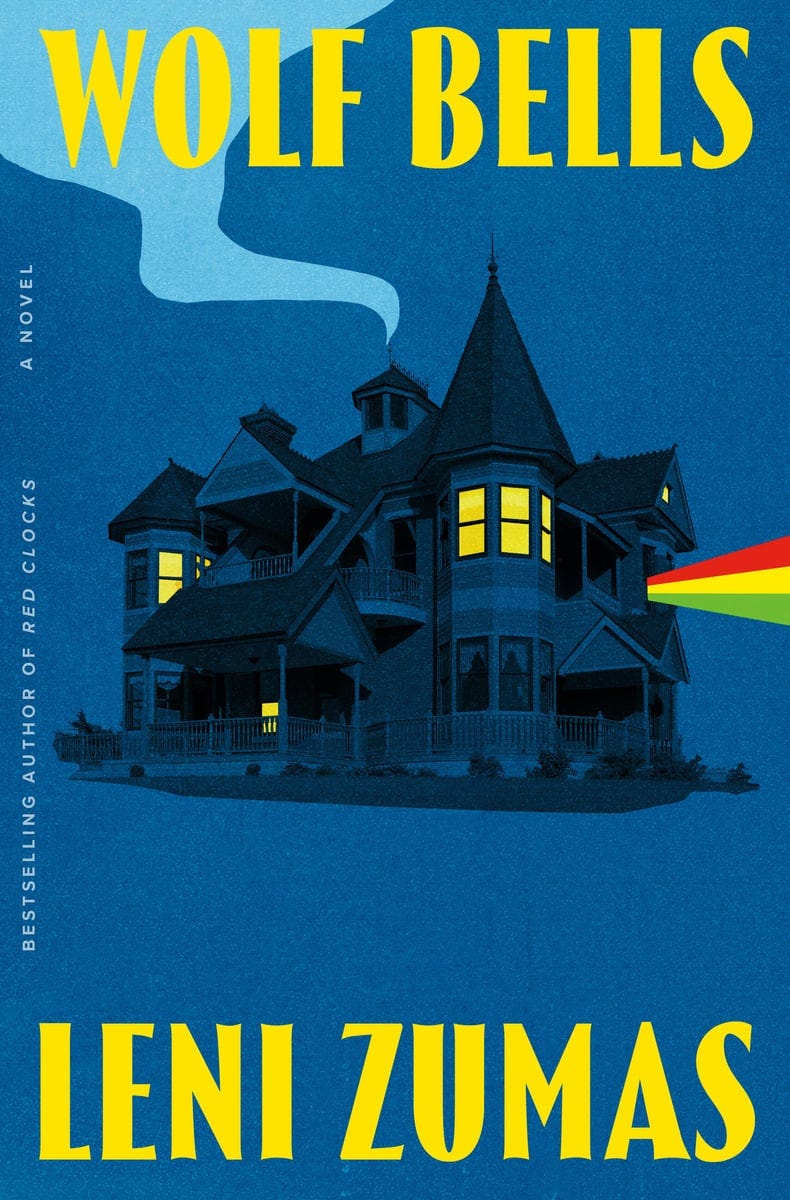
So I pulled her new book, Wolf Bells, off the shelf when it came out this fall, and devoured it. (I’ve now read it three times, and I’m not alone in loving it: NPR called it one of the best books of 2025.)
In Wolf Bells, Zumas creates an intergenerational home, led by a former punk musician named Caz. In her 60s, Caz finds herself responsible for a house full of elderly people, as well as the young people she invites to live there for free, in exchange for cooking and caregiving. The house provides a makeshift safety net for elders who need care, and young people who need a place to live.
“It’s a vision of radical hospitality,” the Washington Post wrote in its glowing review.
Into this mix come Nola and James, two kids who have run away from Child Protective Services, and who arrive on the porch one Halloween night. Nola is a teenager committed to protecting James, her younger cousin, who is autistic. She’s desperate to keep them from being separated. The story unfolds over just a few days, in which Caz tries to reunite the children with a relative, and the house’s residents come to protect the children from systems that would pull them apart.
The novel is packed with characters, including Caz’s best friend and bandmate Vara, who uses a wheelchair, and the nosy pastor who lives next door. One of the house’s young residents is named Ant, a doctoral student. They quote the writer David Graeber, saying, “The ultimate, hidden truth of the world is that it is something we make, and could just as easily make differently.”
I’m obsessed with this idea, that systems of care are designed — and therefore can be redesigned to be more equitable — and even joyful — for all of us. I spoke with Zumas about how she imagines better possible futures, and how she would design a world where everyone belongs. I have edited our conversation for length and clarity.
What was the starting point for you in writing this book?
Well, sprinkled throughout the book there are these references to the Golden Girls, which is schlocky and cheesy, but it is actually one of my favorite shows. I first watched it when I was little, in the 80s. During the pandemic, at night, I watched every single episode of The Golden Girls. And I thought, if I could look forward to this, that would be amazing. This idea, not that everything’s fine, but that there’s a space where there is intimacy and care, even if you’re bickering all the time. And the attention paid to postmenopausal women or perimenopausal women is, in itself, miraculous.
Also, when I started writing it, my son was four or five. He’s autistic, non-speaking. I was starting to encounter just a great sense of isolation as a parent, as a caregiver. He got kicked out of two preschools because of his behavior, and I was really struggling to connect with any other parents of kids with disabilities or kids whose trajectory and care were just different. I mean, we all have the same needs, but the ways that they could get those needs met were going to be different.
So really there was a wish fulfillment in starting to write this book, because I was also imagining: What if I weren’t a middle-class person with a steady job? What if I was poor and exactly the same person, but I just didn’t have the resources?
I had been reading about intergenerational retirement homes. There was something very utopian, but also plastic and romanticized about that idea, you know, as though that would just work so smoothly.
In an interview you did with Kirkus Reviews you talked about how the word “utopia” actually means “no place.” It’s an impossible ideal. So what is motivating the idea behind this house?
I don’t think anything works smoothly, and that’s not the reason not to do it.
Radical politics means we take care of people no matter what, and are taken care of even if we don’t understand or don’t share their experience.
We have to start at: We’re all equal and we’re all human.
I wanted to ask about the idea of “wolf bells” themselves. What are they?
So one of the characters in the novel is an 89-year-old woman named Marika. She’s Greek, she’s Jewish. Her whole family was murdered in the Holocaust, and she eventually made it over to the States when she was a teenager. But in her grandmother’s village in Greece, they had a practice called wearing the bells, where people in the village who were strong enough, physically, would attach bells to their body – around their necks or their ankles – and dance around the herd of livestock, so that if there were stragglers – the very young, or the very old, the sick – those stragglers wouldn’t be picked off by the wolves.
Wait, is this a real thing, or did you invent it for the book?
I invented it. And important to the idea was also that the humans wearing the bells had vulnerability too, but they were less vulnerable. So they could wear armor, or carry knives.
These are the questions that we should be asking: Who do I care for and who will care for me? And how do we expand that answer so that it’s not simply biological offspring and our own parents?
It was sort of an anti-Darwin idea. The ideas we have around survival of the fittest in this country, they completely inform the clown who’s in charge of Health and Human Services. He is really operating according to survival of the fittest. If you’re not healthy, then that’s your own fucking problem.
This one person who’s just strong enough to protect everyone else: How does that person step into that role? Why is that a counter to the idea of survival of the fittest?
I was imagining in this village that it was an honor to wear the bells. It was an honor to be able to protect not just the individual animals, but the well-being and the sustainability of the village, of the community.
So that the animals weren’t seen as disposable. It wasn’t, “Let’s keep as many as we can, but the sick or older young ones can just die in the jaws of a wolf.”
It really dovetails into my thinking with this book. Wouldn’t it be amazing to live somewhere where the whole place was a unit, a team?
On the opening page of the book you write: “To everyone this world wasn’t built for.” Between James, and his sister Nola, and the sick and the elderly, and Caz, a 60-year-old woman having sex with a much younger man, the twenty-somethings struggling to figure out their lives, all of the folks in the house are complicated people — people the world wasn’t quite built for. How did you decide which characters you wanted to build the house around?
I wanted to have female friendships and their discontents, which is, you know, just a perennially interesting thing to write about.
I wanted there to just be a sense that everyone comes as they are to this place. There’s a sort of equality there that was informed by my own experience in the 90s of getting clean and sober and living in a halfway house, because that was my first experience of being in a small community that did operate as a family. People I never would have crossed paths with, based on geography and education and class and a lot of different elements of identity, but we were all not doing well. No one was succeeding in life. We had been sort of removed from mainstream notions of normativity, at least temporarily.
Caz is a character who also had that experience, and is trying to recreate that sense of lateral kinship.
Another book that was really important to me while I was writing this is Roland Barthes’ book, “How to Live Together.”
He talked about this idea of “idiorrhythmy,” the notion that in places – a commune or a monastery – people could live according to their own rhythm, but then, like, just come together for dinner. You didn’t have to conform exactly to how other people lived, but there was something you could share. Maybe someone doesn’t like talking to people that much, or maybe someone is super-extroverted. Both of those people could have space that made sense for them.
The book builds to a very intense climax, and we’re not going to say how the book ends, obviously, but I’m curious if there’s something you know you wanted people to walk away with?
Getting back to the David Graeber quote that you mentioned, I think any of us can expand our conception of what is possible, in terms of how we organize ourselves as a society or as systems of care.
I just keep thinking about the healthcare discourse in this country and how it’s directly related to capitalism. As though capitalism were some inevitability, and it’s not. But there really is a naturalizing and essentializing of certain systems.
I also think about the social model of disability versus the medical model, which is very important. It’s something I’ve learned in the past 10 years or so. It’s the notion – and this really applies to how we view our elders too – that disability isn’t necessarily just some individual deficit or malady that’s attached to a person. It’s actually about whether society is built for you.
If every single public building in your town has no way for you to get inside it, that becomes your problem. But it’s not because of anything wrong with you. It’s because there’s no ramps, or the doors are too small.
If you love this convo, please share on Notes or give it a like or comment. It helps others find our work.
Also! We are running an end-of-year discount on annual subscriptions for just $39.50 to get access to all our interviews and essays. (That’s only $3.29 a month!)


"I was imagining in this village that it was an honor to wear the bells. It was an honor to be able to protect not just the individual animals, but the well-being and the sustainability of the village, of the community." This quote undid me!!
What a beautiful book and conversation! I think so many of us would be honored to "wear the bells" and protect others when we can, if we had systems that made it possible to do so more often. I think many of us mourn the fact that we are only able to do so much to ease suffering--our own and others--in our current systems. I love this framing and metaphor--beautiful and profound.
Love this! And also I've made it my mission to remind everyone at every opportunity that Darwin wasn't "Darwinian"...when we return to the source we find someone who very much valued cooperation and care. https://elissa.substack.com/p/we-got-darwin-all-wrong