
What Does It Really Mean to be "Equal"?
As in: “I don’t want to do more around the house just because I was born with a vagina.”

Thank you for joining thousands who read MR every month! Paid subscribers get access to subscriber chats, all our interviews and thoughtful essays, book clubs, and other paid content that helps keep us sane in these times—for just $5 a month!

The battle over equal partnership is not about who has more money, it’s about who has more time, or at least, more control over their time.
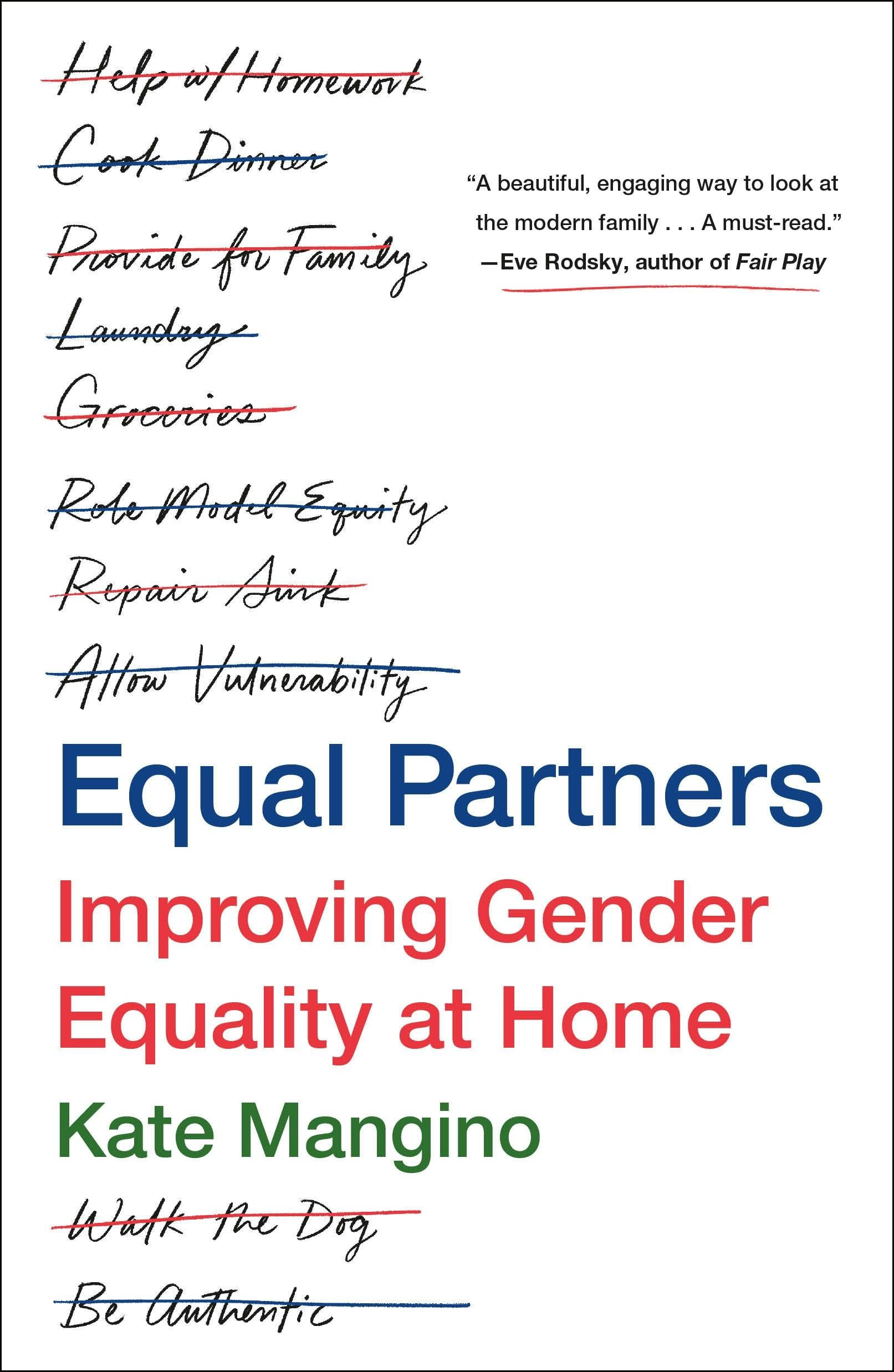
That’s one of the conclusions in “Equal Partners: Improving Gender Equality at Home,” by the writer and researcher Kate Mangino.
The book is a practical guide to uprooting the gendered roles that strangle your time and ramp up your resentments. And it’s not just for straight couples. Same-sex couples can just as easily fall into gendered patterns. Mangino’s whole point is to encourage readers to rethink the gender norms that they’re living by in their own households — using reflection questions and exercises to help prompt some tough conversations. Questions like:
Do you think your partner is content with the division of cognitive labor in your home?
Have you both made sacrifices at work to be more present at home? Has one of you made more sacrifices than the other? How did you come to that decision?
If you had fewer household responsibilities, would you (and do you want to) do more professionally?
Think about the kids in your life. Do you think you are role modeling and/or reinforcing gender equality?
Kate Mangino is a researcher and writer, and has a PhD in Human Rights and Social Development. She writes the great Substack Gender (In)Equality (subscribe here!).
We spoke recently about the book, and I edited our conversation for length and clarity.
What is your top hope for someone who reads this book?
I hope that my book will initiate a conversation about how gender norms might have influenced their decisions and their behaviors, and to understand that your relationship can look any way you want it to look. We can completely rewrite our own rules.
I’m not an advocate, necessarily, for equal partnership. I’m an advocate for intentional decisions.
Instead of just falling into gender patterns because it’s what the default mode is, ask: What is best for you and your partner? How do you want to split things up and have that conversation be regular enough, so that if you want to make a change, there’s room for change?
You have different kinds of categories for different roles, and types of household responsibilities. What are “routine “versus “intermittent” chores, and how do they break down along gender?
These aren’t my own terms. I borrowed these from existing academic journals, but typically speaking, I think one of the reasons why people think we have equal partnerships is because we have these two buckets: there’s the indoor bucket and there’s the outdoor bucket.
The inside bucket is where the routine tasks happen. These are things that happen within the four walls of the house and tend to be things that are around caretaking of humans and animals. It’s taking care of kids, feeding, bathing, cooking.
It’s the relentless daily buildup of tasks.
The outdoor tasks tend to be intermittent. They happen once in a while: mowing the lawn, or weeding the garden, or fixing the car, or balancing a checkbook or checking on investments. There’s a lot of flexibility. “I can’t get to it this weekend, I’ll do it next weekend.”
The indoor tasks take more time than the outdoor tasks, and I think the flexibility piece is really important. If you have to feed the kids every day at 6, then you have to stop work at 5 in order to get that done. But if your task only has to happen every other Saturday, or every other weekend, you can do it whenever you have time.
The task can be done when it’s convenient, versus a task that has to be done regardless of when it is convenient or inconvenient.
How do the differences in that flexibility affect people in a household?
I think it plays out in opportunities that you each have. If I have flexibility of time, then I can schedule my chores when I want to, and that leaves time for say, if I want to take a class, if I want to do an extra shift, or if I want to take a nap, if I want to spend time with kids, if I want to hang out with my buddies, if I want to exercise every day.
Less flexibility means you’re constantly scheduling your life around meeting your chores and tasks.
Right. If you have to pick up your kids from aftercare at 5 on the dot, well, you could be writing the essay of your dreams at 4:30 and you have to walk away from your computer to get there.
Whereas the person who doesn’t do pickup every day and is in charge of a weekend, can finish that beautiful essay. There’s just a huge amount of flexibility in how you get to do all the other things in your life that you care about.
Can you describe “the noticer”? What they do and who they are in the household?
The noticer is who’s noticing the physical stuff that has to be done. Like the clean dishwasher: the noticer sees it and empties it. The noticer walks up the stairs, and sees all the piles of stuff that need to also go up.
The next level is noticing the emotional stuff. My kids are coming home from school with their shoulders down. My daughter’s dragging her feet on doing her reading homework. My son used to be really excited to hang out with his friends on Sunday, but he doesn’t want to go anymore. You’re noticing changes in attitudes and emotions and interactions, and wondering why.

And where’s the gendered element in the noticer?
We raise girls to be conscious of other people, to put other people’s needs before their own.
We’ve seen the research and we know that there’s a significant shift around middle school when girls start to see themselves less as leaders and more as social glue.
My daughter just finished her freshman year of high school, and when they have a treat Tuesday once in a while for their homeroom, who is the one that bakes the cookies on Monday night and brings them on Tuesdays?
It’s just because we have coded girls to be the caregivers and to notice how other people are feeling, and to sacrifice their own preferences for the sake of other people.
There’s plenty of male noticers. I am friends with a lot of them. I talk to them, I interview them. It’s a learned behavior, but it requires practice, and so if you were raised not to notice, then it takes a lot of intentional practice as an adult to build up those skills.
So maybe that’s a good way to shift into maybe talking about what you call the “EP 40”: 40 men who you identified as “Equal Partners.” You write, “The Equal Partner does not need to be told what tasks need to be done around the house. The Equal Partner shares in the emotional burden of the family. He does not accept behavior assigned to him because of his gender identity.”
One thing that I was super interested in was that all of them had some exposure to another way of life, and that 75% were “othered” in some way — perhaps because of their skin color, economic status, or a parent’s substance abuse problem, a disability, or some other reason. I’m wondering what conclusion you draw from that information.
I think that links up very nicely around the research that when people experience empathy, when people are kind and empathetic towards them, they then know how to extend kindness and empathy to others.
There were all these different reasons for why the EP 40 felt othered, but through that experience they probably were humbled, and they remembered what it felt like to be arbitrarily pushed out.
I think later on in their life when they had a partner who explained to them, “I don’t want to do more around the house just because I was born with a vagina.” They got that there was a connection there.
Is there anything I didn’t ask you about that you want people to know about this work?
The one thing that I want to draw attention to is that this is everyone’s business. I think that this topic tends to get stuck in families with kids under 18, get stuck in heteronormative families, kids under 18. But this is not a decision between two people. This is a systematic issue. This has to be talked about with grandparents, with schools, in the health system.
I want the community to be involved in this conversation, and to ask, “What is my connection with the household equity conversation?”
You are at the very busiest of your entire life when you have kids under 18, and we cannot keep asking these parents to solve this problem.
This isn’t household-related, but I’m curious how you would respond to this scenario. At the end of the school year, there were just a flood of requests for school volunteers at my kid’s elementary school: the end-of-year brunch, and setting up for field day and organizing the gift for the class teacher. And guess who was doing all this labor? So my question is: What would be a skillful way for me to make note, publicly, that all this work was being done by working mothers?
I always start with: “How can I do this so it comes from a place of kindness and curiosity, as opposed to blame? How can I build a little team of allies?”
When my daughter was little, I went to an end-of-year assembly for her, and there were four science awards. The first was the newest thinker, and one was the best researcher, and one was the bravest experimenter. They all went to boys.
Then the fourth award was the best caretaker for our science animals, and it went to a girl. My skin was crawling. I ended up reaching out to a bunch of other parents — and no one else cared. So it just gave me the information that I was on my own.
The question was whether there’s enough energy around the issue that there might be systems change. Could this go to the PTA, or is this really my own beef? Then I get to make choices about how I use my time.
If you liked this piece, please hit “like” or restack it, or leave a comment—it’s the best way for my work to find new readers.
Love this point about the indoor and outdoor bucket tasks, and who has flexibility and therefore gets to get a workout or finish writing a book chapter.
I also think about this a lot in terms of tasks that give you adult space vs. those that do not. Ex: Doing laundry or dishes lets you listen to a podcast or a book, and lay on the couch for a few minutes between loads and lets you feel like you're having some adult time. Caring for a small child for 3 hours will NOT give you the same freedom, and is much more depleting.
The indoor/outdoor tasks distinction is really important! I love this Lane. Thanks for the interview.